
Tift County Criminal Court Records
A Tift County criminal court record is the court's case file after a criminal matter moves into court. It is different from an arrest record, jail roster entry, warrant record, police report, or criminal-history background check. The court file tracks the case as it moves through arraignment, motions, plea talks, trial settings, verdicts, dispositions, and sentencing. For a closer look at the charge itself, use the local court charge records page. For the full case file and outcome, criminal court records are the better source.
Superior Court handles felony trials and major criminal matters in Tift County. State Court handles misdemeanor criminal offenses punishable by up to 12 months in jail and a fine, or a higher fine for aggravated misdemeanors. City of Tifton Municipal Court handles city traffic, ordinance, and certain state misdemeanor matters within city limits. Magistrate Court handles arrest warrants, pre-arraignments, bond hearings, warrant hearings, and preliminary hearings. Juvenile Court criminal-type records are not ordinary public criminal court records.
The District Attorney source is the Tifton Judicial Circuit District Attorney's Office.
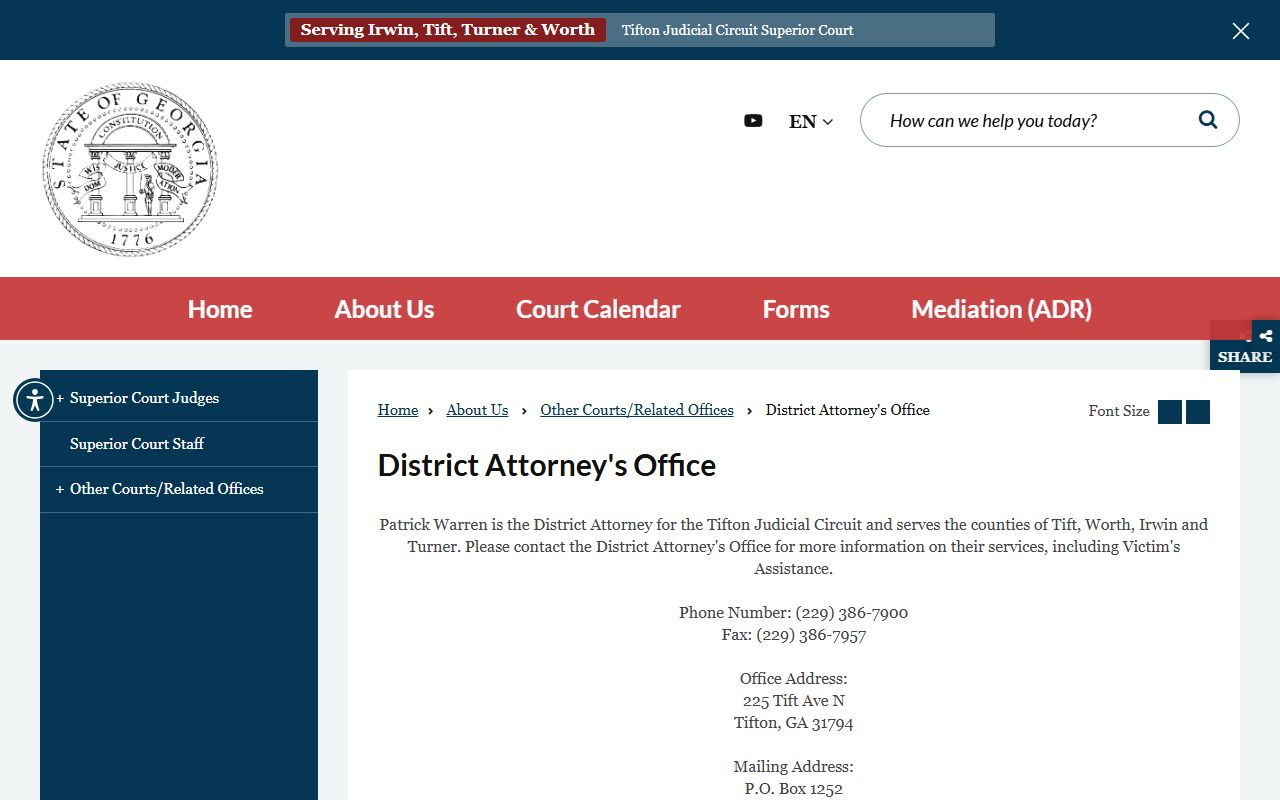
That source ties felony prosecution in Tift County to the Tifton Judicial Circuit, which also includes Irwin, Turner, and Worth counties.
Search Tift County Criminal Cases
Criminal case access starts with the court level. Tift Superior Court and Tift State Court are listed by Georgia Courts eAccess as court-record access points through PeachCourt, and PeachCourt account access is required for full provider searching. The Clerk of Court remains the local case-record office for Superior and State Court criminal filings. State Court's FAQ identifies the Clerk as the official keeper of State Court records and lists a record-copy phone. Municipal and Magistrate criminal-related matters should be checked with those courts when they are the source of the entry.
- Decide whether the matter is a felony, misdemeanor, city case, warrant event, bond hearing, or juvenile matter.
- Use the PeachCourt/eAccess route for Tift Superior or Tift State Court if account access is available.
- Search by defendant name, case number, court, case type, filing date, citation number, or hearing date when those fields are available.
- Read the docket entries for arraignment, motion, plea, disposition, sentence, probation, fines, and restitution.
- Request certified copies from the Clerk of Court or the court that owns the case if the record will be used for official purposes.
The Solicitor-General prosecutes State Court misdemeanors, investigates crimes, interviews victims and witnesses, files accusations, subpoenas witnesses, collects evidence, negotiates pleas, and tries cases. The official source is Tift County's Solicitor-General page.
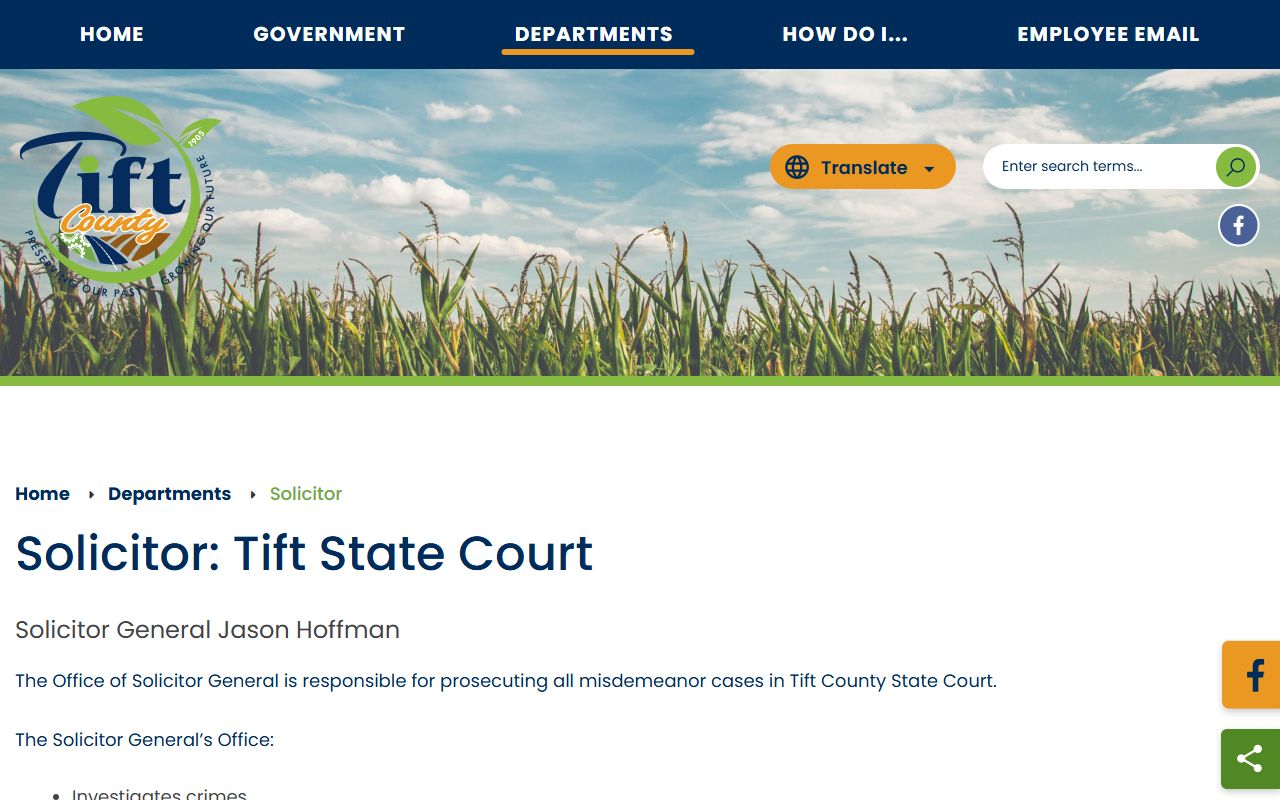
This source supports the misdemeanor side of Tift County criminal court records, where accusations, pleas, and trials appear in State Court files.
Tift County Criminal Case Flow
A criminal court record grows as the case moves from accusation or indictment to final outcome. Some early criminal events, such as arrest warrants, bond hearings, or preliminary hearings, may involve Magistrate Court. The main criminal case file later sits with the court that hears the charge. Felony files belong in Superior Court. Misdemeanor files usually belong in State Court or Municipal Court depending on the offense and venue.
Case flow: Charges Filed › Arraignment › Pretrial and Motions › Plea or Trial › Disposition › Sentencing
| Stage | What Happens | Record Clue |
|---|---|---|
| Charges filed | A prosecutor files an accusation, or a felony charge may proceed by indictment. | Charge, statute, count, accusation, indictment, or warrant reference. |
| Arraignment | Charges are formally presented and a plea may be entered. | Arraignment date, plea, judge, and counsel notes. |
| Pretrial and motions | Parties file requests, evidence issues are heard, and court dates may change. | Motions, orders, continuances, subpoenas, and hearing entries. |
| Plea or trial | The case is resolved by plea, trial verdict, dismissal, or other court action. | Plea, verdict, dismissed count, reduced count, or nolle prosequi entry if shown. |
| Disposition | The court records the result for each charge or case. | Guilty, not guilty, dismissed, acquitted, nolo, or other outcome language. |
| Sentencing | The court imposes jail, probation, fine, restitution, treatment, or other terms. | Sentence, probation, costs, restitution, and compliance conditions. |
The Prosecuting Attorneys' Council source for local prosecutors is the PAC Georgia Tift County prosecutor directory.

That directory confirms the local split between District Attorney and Solicitor-General roles for Tift County criminal matters.
Tift County Criminal Record Fields
Tift County criminal court records should be read at the charge level and the case level. A single case may have more than one count. Each count may have its own charge, statute, plea, disposition, and sentence. The research did not capture a public PeachCourt sample display without account access, so this table gives a cautious field inventory from the court-record research rather than a guarantee of what every online result shows.
| Field | What It Shows |
|---|---|
| Case number | The court or provider identifier assigned to the criminal file. |
| Defendant | The person charged in the criminal case. |
| Court | Superior Court, State Court, Municipal Court, Magistrate Court event, or Juvenile Court when restricted. |
| Charge | The offense alleged by accusation, indictment, warrant, citation, or other charging document. |
| Statute or count | The code section or count label tied to each offense when entered. |
| Plea | The defendant's response, such as guilty, not guilty, or nolo contendere. |
| Docket entries | Arraignment, motion, hearing, continuance, order, subpoena, trial, disposition, or transfer events. |
| Disposition | The result for a case or charge, such as guilty, not guilty, dismissed, acquitted, or other outcome. |
| Sentence | Jail, probation, fines, restitution, treatment conditions, and other court-ordered terms. |
| Redactions | Information withheld by law, court order, juvenile record limits, or record restriction rules. |
Charges vs Convictions
A charge is an allegation filed in court. A conviction is a final outcome after a guilty plea, nolo plea where treated by law, or guilty verdict. Tift County criminal court records may show charges that were amended, reduced, dismissed, not prosecuted, or resolved by acquittal. This is why a docket entry must be read through the disposition and sentence, not stopped at the charging line.
| Point | Charge | Conviction |
|---|---|---|
| Meaning | An offense alleged by the state or city. | A final finding or plea that results in guilt for the offense. |
| Timing | Appears early in the criminal case. | Appears after plea, verdict, or final disposition. |
| Record risk | Can appear even if later dropped or dismissed. | Usually connects to sentence, probation, fines, or other judgment terms. |
| Best field to check | Charging document, count, statute, and docket entries. | Disposition, plea, verdict, sentence, and probation entries. |
Charges are covered in more detail in Tift County arrest records and court charges, while the full court case outcome stays with the criminal court record.
Tift County Criminal Defense Records
The presence of a public defender or appointed counsel note can matter when reading a criminal court docket. Tift County's Public Defender page provides the local contact for defendants who cannot afford counsel. The court record may show counsel appearances, motions, hearing dates, plea entries, and sentencing outcomes, but it should not be treated as legal advice or a full defense file.
The source image comes from the Tift County Public Defender page.
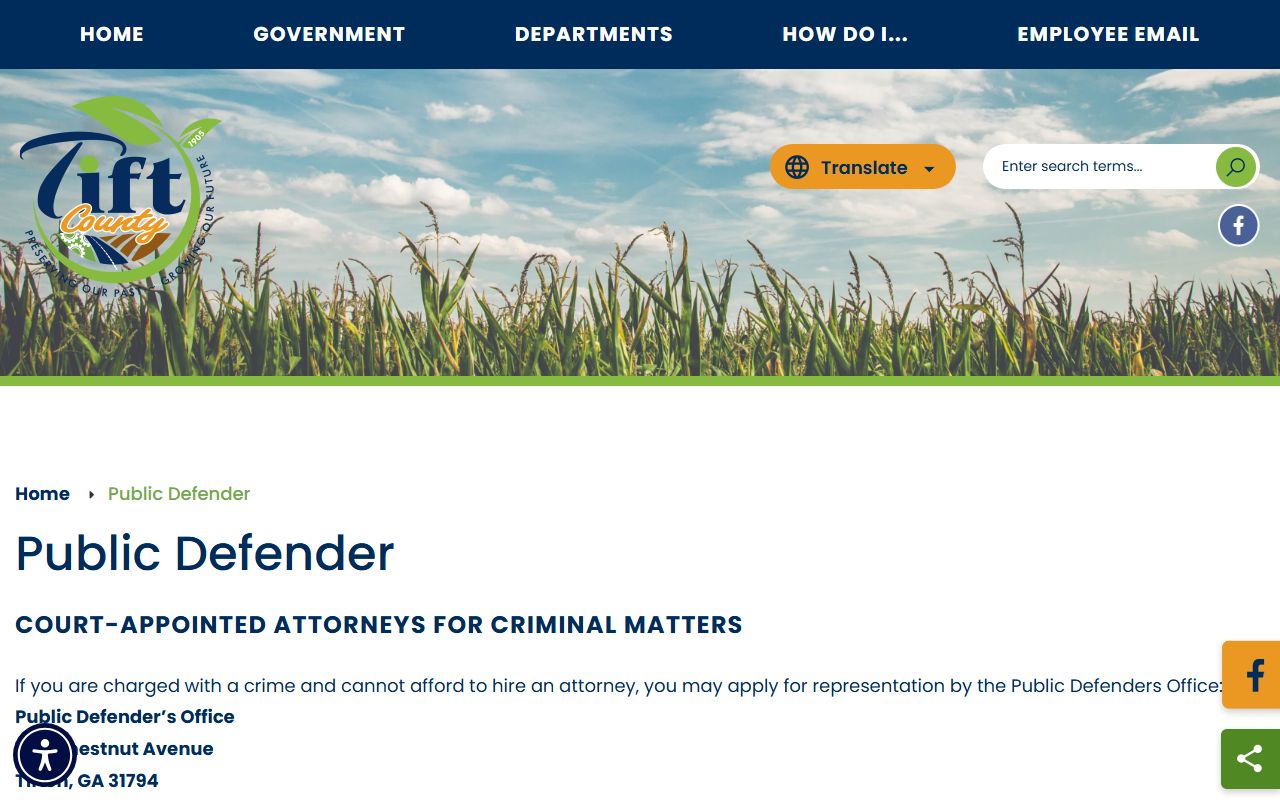
This source connects criminal case records to the local office that may appear in docket entries for eligible defendants.
Sealed vs Restricted Records
Georgia sources use record restriction for eligible criminal history limits under O.C.G.A. 35-3-37, while sealed court records may be hidden because of law, court order, or court rule. The terms should not be blended. A sealed court file concerns access to the court file or parts of it. Record restriction concerns how eligible criminal history is limited from non-criminal-justice access. Local police and sheriff sources list record-restriction processing fees, but the research did not find a local Tift County court fee table for sealing court files.
| Point | Sealed Court Record | Restricted Criminal History |
|---|---|---|
| What it affects | Court-file access or parts of a case file. | Eligible Georgia criminal history for non-criminal-justice purposes. |
| Source of limit | Law, court order, or court rule. | O.C.G.A. 35-3-37 and prosecutor or agency approval where required. |
| Local route | Ask the court that holds the case file. | Start with the arresting agency and prosecutor path described by local sources. |
| Research gap | No local court sealing fee table was found. | Police and sheriff pages list restriction processing fees, but route depends on agency and prosecutor. |
The statute source image comes from O.C.G.A. 35-3-37.
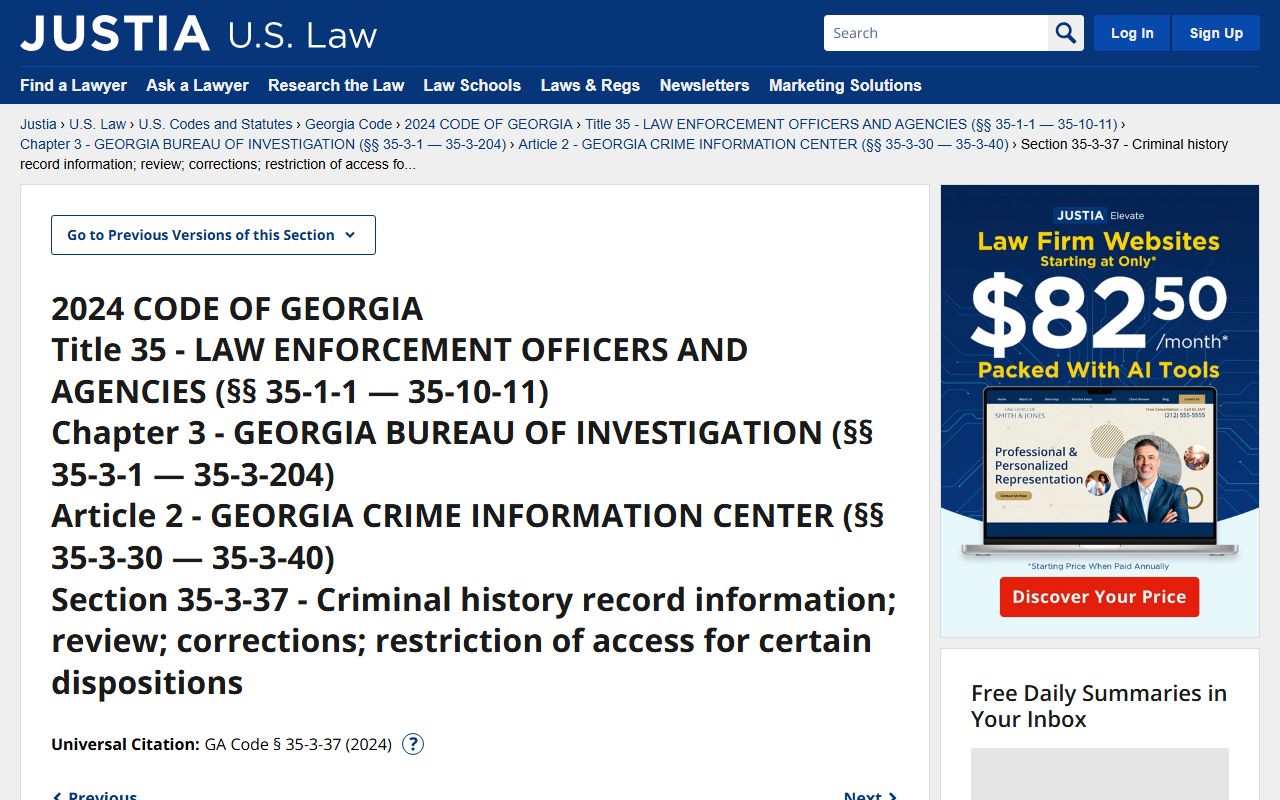
This statute source supports the distinction between Georgia record restriction and general sealed court-file access.
Public Access to Criminal Records
Georgia's open-records framework includes a public-record presumption under O.C.G.A. 50-18-70, but criminal court records are still limited by court rules, exemptions, sealing orders, juvenile restrictions, and redaction rules. Uniform Superior Court Rule 21 states that court records are available for inspection unless limited by law, court order, or court rules. In practice, Tift County criminal court records may be public at the docket or case-file level while still hiding Social Security numbers, financial account data, protected victim identifiers, juvenile material, and restricted criminal history details.
Juvenile Court deserves special care. The research file identifies O.C.G.A. 15-11-700 to 15-11-710 as the juvenile court access and record-law area. Juvenile law-enforcement and court files should not be treated as ordinary adult criminal court records. Adoption and mental-health access were not detailed in official Tift County sources, so those categories should be treated as restricted where state law or court order applies.
Key access point: Public criminal case access does not mean every field is public, and certified copies still come from the record custodian.
Criminal Records Outside Court
Some criminal-record tools are not court records. The Georgia Bureau of Investigation sex offender registry is a statewide registry source under O.C.G.A. 42-1-12. It is separate from the Clerk of Court, PeachCourt, the Tift County jail roster, and the court docket. Georgia Department of Corrections and federal prison tools also track custody after sentencing or transfer, not the local criminal court file itself.
The registry source is the Georgia Bureau of Investigation sex offender registry page.
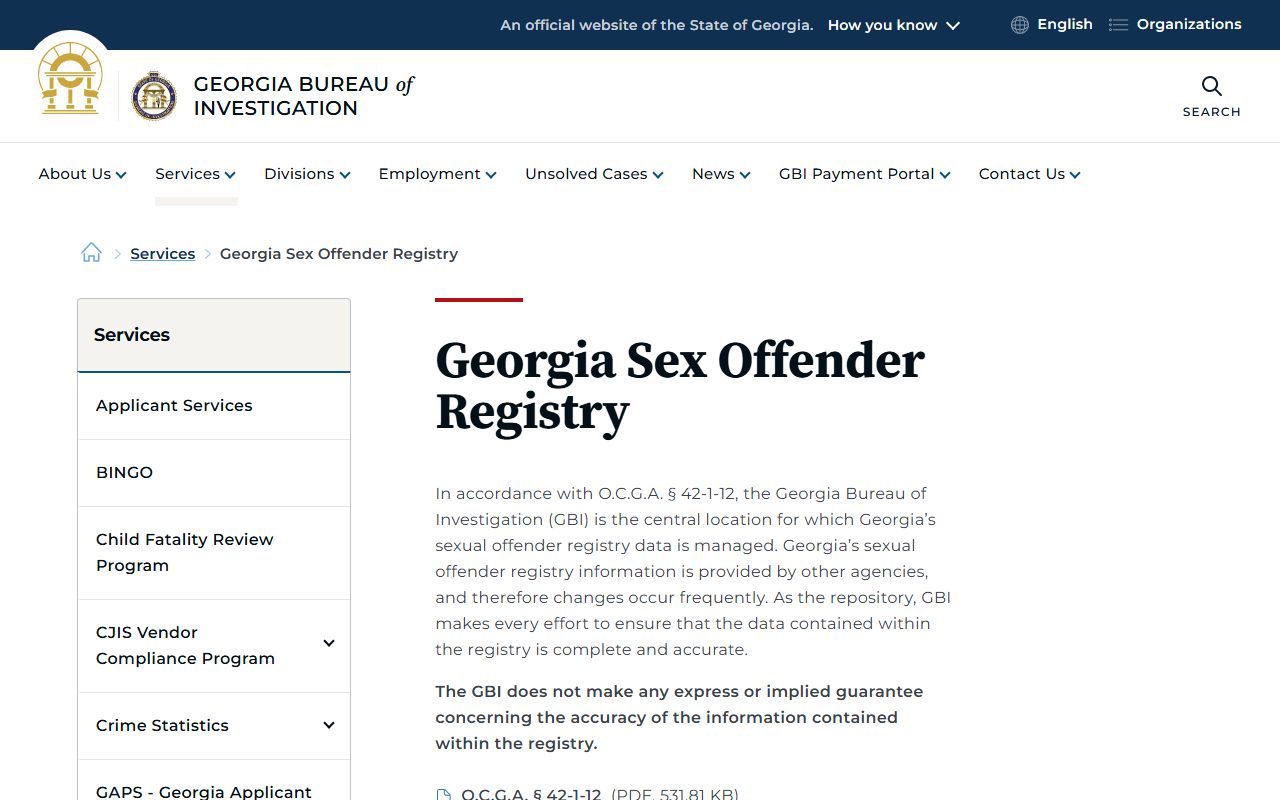
The registry image is relevant to criminal-record research, but it should not be read as a Tift County criminal court docket or case file.
Tift County Criminal Record Contacts
Use the Clerk of Court for Superior and State criminal case records and certified copies. Use State Court contacts for misdemeanor record questions, and use the Municipal Court Clerk for city matters within Tifton. Felony prosecution questions belong with the District Attorney, while misdemeanor prosecution in State Court belongs with the Solicitor-General. Public Defender contact is separate and relates to defense eligibility, not public record copies.
Clerk of Court
237 E. 2nd Street
Tifton, GA 31794
229-386-7810
Monday-Friday 8:00 a.m.-5:00 p.m.
District Attorney
225 Tift Ave N
Tifton, GA 31794
229-386-7900
Felony prosecution for the Tifton Judicial Circuit.
Solicitor-General
225 C Tift Avenue, Suite 3
Tifton, GA 31794
229-386-7950
State Court misdemeanor prosecution.